HIPS vs PVA: Best Dissolvable Support for ABS Architectural Models
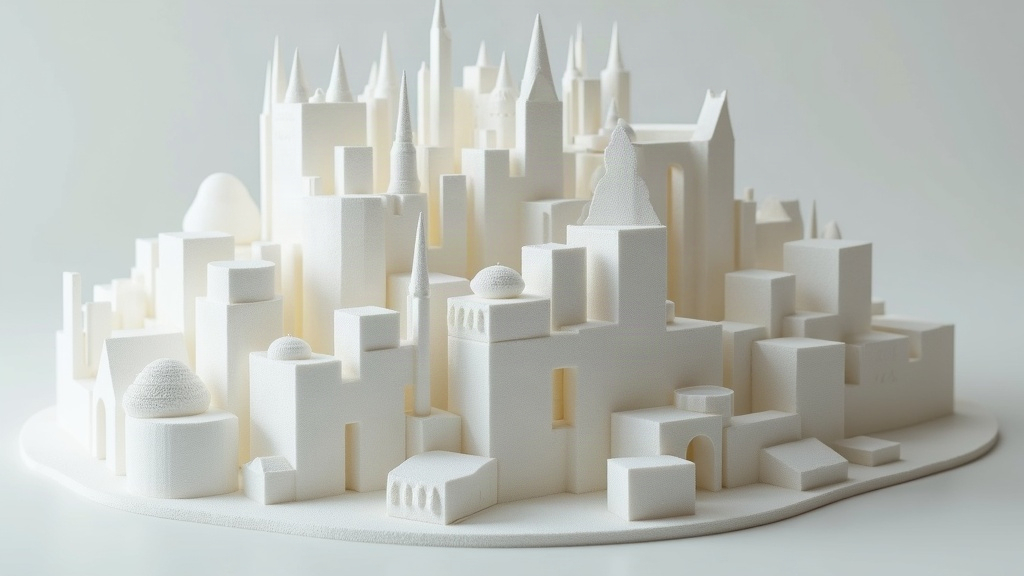
If you build intricate ABS architectural models (facades with deep window recesses, cantilevered balconies, or lattice roof structures), choosing the right dissolvable support material can make or break your print quality. The short answer: HIPS dissolves in limonene and pairs naturally with ABS’s printing temperature and shrinkage behavior, while PVA dissolves in plain water but is chemically and thermally better matched to PLA, not ABS. For most ABS architectural work, HIPS is the more reliable choice, though PVA has a few niche advantages worth knowing about before you commit.
Why Support Material Choice Matters for Architectural Models
Architectural models need support almost everywhere. Deep interior courtyards, thin cantilevers, spiral stairs, overhanging cornices… all of it requires material that holds geometry during the print and then disappears cleanly afterward, without wrecking the delicate features you spent hours tuning. Get the match wrong and you’ll run into:
- Warping from thermal stress during printing
- Support that won’t fully dissolve, leaving residue buried in fine details
- Weak bonding between support and model, which shows up as interlayer shifting
- Long soak times that risk softening or distorting the model itself
HIPS as a Support Material for ABS
HIPS (High Impact Polystyrene) has been the go-to dual-extrusion partner for ABS for years, and there’s a reason it stuck around.
Temperature and Shrinkage Compatibility
HIPS prints at roughly 220-250°C, which lines up closely with ABS’s typical 230-250°C range. Both materials shrink at similar rates as they cool, so you get less warping and fewer layer separation issues. That matters a lot when you’re printing tall, thin architectural columns or narrow window mullions that can’t afford to drift even half a millimeter.
Dissolving Process
HIPS dissolves in d-limonene, a citrus-based solvent (yes, it smells like orange peel). The process usually takes 2-12 hours depending on part thickness and how dense the supports are. Limonene is:
- Effective on fully encapsulated supports (interior rooms, enclosed stairwells, the stuff you can’t reach with a pick)
- Gentle on ABS, since ABS itself doesn’t dissolve in limonene
- More expensive and requires proper ventilation plus a dedicated dissolving tank, so it’s not quite a kitchen-counter operation
Best Use Cases
- Enclosed structures like interior floor plans or sealed facade cavities
- Models that need high dimensional accuracy once supports are gone
- Projects where long-term durability matters (HIPS resists UV yellowing a bit less than ABS, but the bond quality between the two stays strong regardless)
PVA as a Support Material
PVA (Polyvinyl Alcohol) has one big selling point: it dissolves in plain water. No solvents, no fumes, no tank in the garage.
Temperature Mismatch with ABS
PVA typically prints best around 190-220°C, which is noticeably cooler than ABS. That gap causes real problems:
- Poor adhesion between support and build material
- A higher risk of delamination on tall architectural spires
- Inconsistent extrusion if your dual-extruder setup can’t handle a wide temperature spread between nozzles
Moisture Sensitivity
PVA is hygroscopic, meaning it soaks up ambient moisture fast. Leave it out overnight and it can turn brittle or start clogging your nozzle. For long architectural prints, the kind that run 10+ hours, that’s exactly the sort of thing that causes a mid-print extrusion failure at 2 a.m. while you’re asleep.
When PVA Still Makes Sense
- Small-scale models where speed and simplicity matter more than precision
- Hobbyist setups without ventilation for a limonene tank
- Prints that combine PLA elements alongside ABS sections (rare, but it happens in mixed-material builds)
Head-to-Head Comparison
| Factor | HIPS | PVA |
|---|---|---|
| Solvent | D-limonene | Water |
| Print temp match with ABS | Excellent | Poor |
| Dissolve time | 2-12 hours | 1-6 hours |
| Storage needs | Low humidity preferred | Airtight, very moisture-sensitive |
| Cost per spool | Moderate | Higher |
| Best for | Enclosed, complex ABS geometry | Simple overhangs, mixed-material prints |
Practical Recommendations
- Use HIPS when printing fully enclosed architectural interiors, think stairwells, hidden structural supports, multi-floor cavities. Limonene reaches places water-soluble supports sometimes can’t clean out thoroughly, and it won’t swell the model while it works.
- Dial in your dual-extruder temperatures carefully. If you absolutely have to pair PVA with ABS, nudge the ABS nozzle a bit hotter and cut the PVA flow rate back to improve layer bonding.
- Store PVA in a dry box with desiccant. Even a few hours of open-air exposure can ruin an entire spool, no exaggeration.
- Test on a small sample module first, before you commit to a full architectural build. Support failure almost always shows up in the first few support-contact layers, so a quick test piece saves you an 18-hour print gone wrong.
Conclusion
For intricate ABS architectural models, HIPS stays the better dissolvable support choice: matched print temperature, predictable shrinkage, and reliable limonene dissolution, particularly for enclosed or structurally complex geometry. PVA works better when it’s paired with PLA, or in simpler support scenarios where water-solubility and convenience matter more than precision. Pick based on your model’s complexity, your workshop’s ventilation situation, and how much post-processing time you’re actually willing to spend.