SLA vs DLP Resin Printing for Lost-Wax Casting Silver Rings
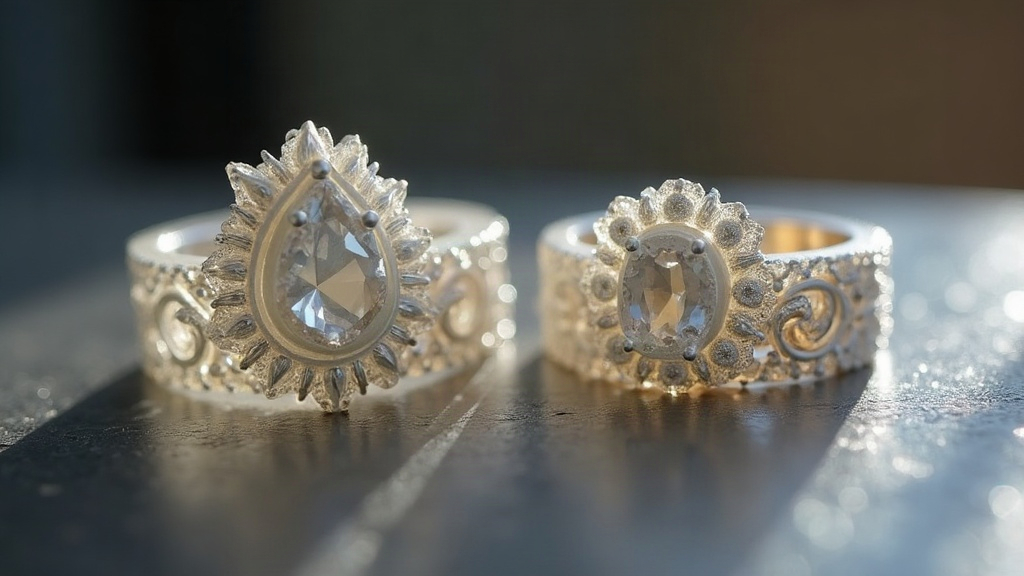
If you’re building custom silver rings through lost-wax casting, the printer technology you pick directly affects surface finish, casting success rate, and how much post-processing you’ll end up doing at the bench. The short version: SLA (laser-based) tends to deliver finer, more consistent detail on small jewelry geometry, while DLP (projector-based) runs faster and costs less per piece, though it carries slightly more risk of visible layer banding on curved shanks. Which one’s right for you comes down to ring complexity, batch size, and what you’re willing to spend.
How SLA and DLP Actually Differ for Jewelry
Both technologies cure liquid castable resin layer by layer. The light source is where they part ways.
- SLA (Stereolithography) uses a focused laser that traces each layer point by point. That gives extremely fine XY resolution, often down to 25-50 microns, and smoother curves. That precision matters when you’re dealing with engraved details, filigree, or pavé settings.
- DLP (Digital Light Processing) uses a projector to flash an entire layer at once. It’s much faster for batches, but resolution depends on the projector’s pixel size. On a printer with a coarse pixel pitch (over 50 microns), you can end up with micro-stepping on rounded shanks.
For a single statement ring with intricate texture, SLA usually wins on finish. For a jeweler cranking out 20+ ring blanks a week, DLP’s speed advantage often outweighs that minor resolution tradeoff.
Why This Matters for Lost-Wax Casting Specifically
Lost-wax casting is unforgiving. Every printed imperfection gets replicated in metal, no exceptions. Two factors matter most here.
1. Burnout Behavior of Castable Resin
Castable resins are formulated to burn out cleanly in a kiln without leaving ash residue that cracks investment molds. Both SLA and DLP-compatible castable resins (Formlabs Castable Wax, Anycubic Castable, Siraya Tech Build, take your pick) perform similarly on this front. Resin chemistry matters more than the printer type. What actually differs is wall thickness consistency: DLP’s pixel-based curing can leave micro-ridges that trap extra resin in corners, which slightly raises the risk of incomplete burnout in thicker sections.
2. Surface Detail Transfer to Metal
Silver casting amplifies every surface imperfection, no matter how small. A layer line that’s practically invisible on the printed wax turns into a visible ridge on the cast ring the moment polishing gets skipped. SLA’s smoother curves generally need less hand-finishing before casting, which saves real time at the bench, sometimes 15-20 minutes per piece depending on complexity.
Practical Comparison Table
| Factor | SLA | DLP |
|---|---|---|
| Detail on filigree/engraving | Excellent | Very good |
| Print speed (batch of 10 rings) | Slower | Faster |
| Cost per printer | Often higher | Often lower |
| Layer lines on curved shanks | Minimal | Possible if pixel size is coarse |
| Best for | One-off, high-detail pieces | Production batches |
Which Should You Choose?
Choose SLA if:
- You make one-of-a-kind or bridal rings with fine engraving
- You want minimal post-print sanding before investing
- Finish quality matters more to you than cost per unit
Choose DLP if:
- You run a production shop casting multiple rings per batch
- Your designs lean toward simpler bands, stacking rings, or solitaire mounts
- You need faster turnaround to keep custom orders moving
Plenty of professional jewelry studios just run both machines: SLA for showcase or bridal pieces, DLP for everyday production. If your budget only stretches to one printer, look for a DLP unit with a high-resolution 4K or 8K masking LCD/projector. That closes most of the detail gap while keeping the speed advantage intact.
Tips Regardless of Printer Type
- Always use resin specifically labeled “castable.” Standard SLA/DLP resins leave too much ash behind.
- Support placement matters more than the printer brand: keep supports off visible band surfaces.
- Run a sacrificial print through your kiln burnout schedule before committing a full batch to it.
- Clean prints thoroughly in isopropyl alcohol before curing. Leftover resin on the surface causes porosity once it hits cast metal.
Conclusion
Both SLA and DLP can turn out castable wax models good enough for professional silver ring casting. SLA stays the stronger choice when the details absolutely cannot be off. DLP is the smarter pick when speed and volume drive the business. Match the machine to your typical order: intricate custom pieces favor SLA’s precision, production runs reward DLP’s throughput. Get that match right and your casting success rate improves no matter which machine sits on your bench.